

Gas detectors are becoming part of a broader safety transformation. They are no longer used only as stand-alone warning devices in defined risk zones. Increasingly, they must work in compact portable instruments, battery-powered installations, connected industrial systems and intelligent safety networks. This changes the requirements placed on the sensors at the heart of these devices: size, energy consumption, robustness, long-term stability and digital integration are becoming just as decisive as reliable gas measurement itself.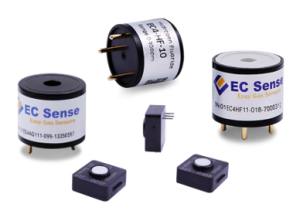
Gas detection has always been a matter of trust. Whether in chemical plants, energy infrastructure, confined spaces, environmental monitoring or personal safety equipment, the sensor inside a detector must work when it is needed most. But portable devices are now worn on the body for years, stationary systems require less maintenance, and digital platforms need sensor data that can be integrated, evaluated and transmitted.
“The classic gas detector is no longer just a box that gives an alarm,“ says Peter Koller, Managing Director of EC-Sense, a Germany-based manufacturer of Solid-Polymer gas sensors and sensor modules for industrial, environmental and safety-related applications. “It is increasingly becoming part of a connected safety system. That places completely new demands on the sensor technology inside the device.“
For decades, electrochemical gas sensors have largely been based on liquid electrolytes. This principle has proven itself in many applications, but it also brings limitations. Liquid electrolyte sensors require space, contain a medium that can move or leak, and may be affected by humidity, ageing processes or mechanical stress. In portable detectors, which are continuously moved and tilted, this can become a practical challenge.
The Sensor Determines the Device
Modern portable gas detectors have to be small, light and reliable. They are worn by workers throughout the day and often have to operate for several years on one battery. In such devices, every millimetre counts. If the sensor becomes smaller, manufacturers can reduce the detector size or use the freed-up space for larger batteries, additional electronics and further safety functions, from GPS positioning to wireless communication or “Person Down Detection“.
EC-Sense addresses this development with Solid-Polymer gas sensors. Unlike conventional electrochemical sensors with liquid electrolytes, the electrolyte is no longer present as a liquid. Instead, the functional sensor structure is realised in solid form on a compact ceramic basis. OEMs integrate the sensors into their own gas detectors and develop their own electronics and system architecture around them.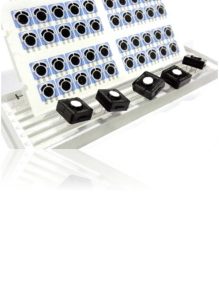
“The decisive point is not simply that the sensor is smaller,“ says Koller. “A smaller sensor gives device manufacturers more freedom. They can design more compact detectors, integrate additional functions or extend the battery life. This can become a real competitive advantage.“
Several internationally active manufacturers of portable and stationary gas detectors are already using or evaluating Solid-Polymer gas sensors in new device generations. One established portable gas detector manufacturer uses the compact sensor design to offer particularly small devices with a guaranteed battery life of more than three years.
Why Liquid Can Become a Limitation
The move from liquid to solid is not a purely academic distinction. Conventional electrochemical sensors contain a liquid electrolyte. If the sensor is moved, shaken or exposed to strong changes in position, this liquid can shift inside the sensor. In portable applications, this may cause short-term signal deviations or false alarms. In the worst case, leaking electrolyte can damage or corrode the detector electronics.
Solid-Polymer sensors eliminate this risk because there is no liquid medium that can escape. They are also less sensitive to movement-related effects. This improves mechanical robustness in devices that are carried on the body, used in mobile maintenance operations or exposed to demanding handling conditions.
“Leakage has always been one of the weak points of classical liquid electrolyte sensors,“ explains Koller. “If there is no liquid electrolyte, this risk disappears. For manufacturers, that means fewer design restrictions and a higher degree of reliability in the final device.“
Long-term signal quality is another factor. Conventional sensors often contain additional materials and components needed for manual production and sealing. Over time, these materials may age and influence the zero signal. Drift and noise can increase, which may lead to more frequent calibration or reduced measuring accuracy. Solid-Polymer sensors are built with fewer components and manufactured by using automated processes. According to Koller, this improves reproducibility and can roughly double the signal-to-noise ratio compared with previous designs.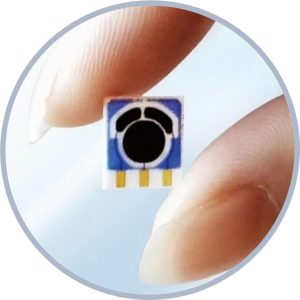
More Predictable Maintenance for Stationary Systems
In stationary gas detection however, miniaturization is not always the priority. Here, long-term stability, resistance to environmental influences and predictable maintenance become essential. Very dry air is one example. Conventional liquid electrolyte sensors can fail permanently after a relatively short period under extremely low humidity, because the electrolyte reservoir dries out. Solid-Polymer sensors behave differently. Under such conditions they may lose part of their sensitivity, but they do not necessarily fail irreversibly. After recalibration, they can continue operating. Additionally, the solid polymer sensors recover from such effects in a matter of hours by placing them in an environment with regular conditions.
Another advantage is the possibility of extended self-diagnostics. EC-Sense has developed electronic test functions that provide information about the ageing state of the sensor. Instead of merely distinguishing between “working“ and “defective“, the sensor can be monitored more continuously. The Lifetime Test indicates whether the sensor is still operating within its optimum range, whether it is approaching the end of its service life or whether replacement should be planned.
“In safety-critical installations, maintenance should not be a guessing game,“ says Koller. “If the sensor can provide information about its own condition, operators can plan service work before a failure occurs.“
From Individual Devices to Sensor Networks
The importance of gas detection is expanding. In the past, gas detectors were often installed at known danger points. Today, many applications aim to monitor larger areas more continuously: industrial facilities, airports, aircraft, urban air quality networks or environments in which risks may develop gradually and over wide areas. To make such systems feasible, large numbers of compact, energy-efficient and connectable sensors are needed.
Digitalization strengthens this development. A single detector can warn about a local hazard. A network can show where a gas cloud is located, how it is moving and which people or assets may be affected. When gas measurements are combined with location data, weather data, airflow, temperature and humidity, a more complete situational picture emerges.
The compact design of Solid-Polymer sensors also creates new form factors. Gas detection can be integrated into rugged industrial smartphones, ID cards, helmets or other personal protective equipment. In such applications, the sensor becomes a safety function within a broader digital tool.
Conclusion: Smaller Sensors, Larger Possibilities
The shift from liquid electrolyte sensors to Solid-Polymer technology is more than a change in materials. It affects the design of portable gas detectors, the maintenance strategy of stationary systems and the way gas data can be integrated into connected safety architectures. Compact size creates space for longer battery life and additional functions. Leakage-free construction improves robustness. Automated production and fewer components support reproducible quality and long-term stability. Extended self-diagnostics make maintenance more predictable.
For manufacturers of modern gas detectors, these characteristics are becoming increasingly important. The market is moving towards smaller devices, longer operating times, lower maintenance effort and stronger digital integration. Solid-Polymer gas sensors, e.g. from EC-Sense, provide a technological basis for this development and open up new possibilities for portable, stationary and networked gas detection systems. In the coming years, the decisive question may no longer be whether gas detection is needed, but where it can be integrated next.
Read other recent news: https://industrial-compliance.co.uk/category/news/


