Business resilience reviews tend to focus on people, buildings, IT systems, utilities and supply chains. Hazardous material storage rarely gets the same attention, despite playing a real role in operational resilience, regulatory compliance and business continuity. The extreme heat the UK has experienced in recent years is a useful reminder of why that needs to change, says Mike Brodie, Managing Director, Chemstore UK.
When temperatures first exceeded 40°C in the UK, many organisations questioned whether their buildings and equipment were prepared for such conditions. It also exposed a broader yet less widely discussed issue that Chemstore regularly comes across; storage solutions specified years ago, against historical operating conditions, may no longer reflect today’s increasingly variable climate.
Alongside considering whether a unit is compliant or in good condition, organisations storing hazardous substances need to understand how the substance’s properties interact with the environment it’s stored in, year-round.
Every hazardous substance has specific storage requirements, many of them temperature-dependent, set out in the product’s Safety Data Sheet (SDS) to reflect its physical and chemical characteristics. Exceed the recommended storage temperature and you risk affecting product stability, increasing vapour generation, or accelerating chemical degradation. Fall below it, and freezing conditions can alter viscosity, damage packaging, affect handling, or compromise containment. From a resilience standpoint, these factors can interrupt operations, raise the likelihood of incidents, and create risk that was entirely avoidable.
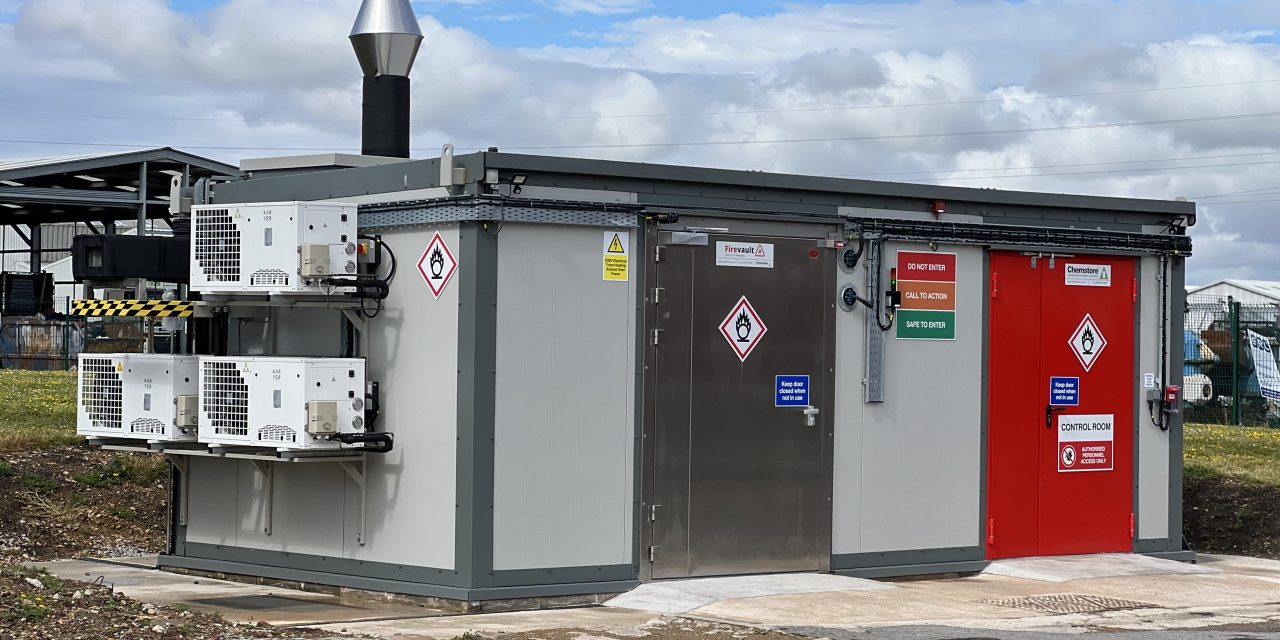
It’s also worth remembering that conditions experienced by hazardous materials don’t necessarily match the ambient weather reported outside. Direct sunlight can push temperatures inside a poorly insulated steel storage unit well above the air temperature, while exposed locations may sit at prolonged sub-zero conditions through winter. As climate variability increases, how storage performs across the full year becomes an increasingly relevant part of assessing operational risk, which is exactly why hazardous material storage belongs in wider resilience planning, not just in a compliance checklist.
The growing use of lithium-ion batteries makes the point clearly. Government guidance has flagged a rise in battery-related fire incidents reported by fire and rescue services, prompting updated advice on managing the risk. Elevated temperatures are rarely the sole cause of these incidents, but they can contribute to thermal runaway in batteries that are already damaged, degraded or mishandled. As a result, organisations are increasingly expected to factor in ventilation, storage density, segregation, inspection regimes and environmental conditions when deciding how batteries should be stored.
The same logic extends across hazardous substances generally. Flammable liquids, corrosives, oxidising agents and temperature-sensitive chemicals each carry different hazards and may need different storage environments because a solution that suits one product may be entirely wrong for another, even when the units themselves look near-identical.
That’s where competent specification matters. Standard hazardous material stores are widely available and, in some cases, entirely appropriate. The critical decision is matching the storage to the hazard and the environment it will operate in which means weighing the hazardous properties of the substances involved, the quantities stored, site conditions, ventilation needs, seasonal temperature swings, and relevant legislative duties such as the Dangerous Substances and Explosive Atmospheres Regulations (DSEAR).
Seen this way, hazardous material storage is no different to any other critical safety control. Few organisations would select fire detection systems, electrical protection or process safety equipment without first understanding the risks they’re meant to manage. Storage deserves the same scrutiny.
There’s a commercial dimension too. Incidents involving hazardous substances can mean operational downtime, product losses, environmental remediation, enforcement action, insurance claims and reputational damage. Compliance remains essential, but resilience means going further and asking whether existing controls still hold up as products, operations and environmental conditions change.
The current focus on climate resilience is an opportunity to widen that conversation. Reviewing hazardous material storage alongside wider business continuity planning helps organisations catch vulnerabilities before they become incidents, and encourages a more holistic view of risk where safe storage isn’t just about regulatory compliance, but about protecting people, preserving assets and maintaining operational continuity.
Read other recent news: https://industrial-compliance.co.uk/category/news/