On brownfield sites, where ground conditions can be unpredictable and contamination risks are high, specifiers need drainage systems that are both resilient and sustainable. Vitrified clay pipes (VCPs) provide a proven long-lasting solution, with performance characteristics that make them particularly well-suited to the challenges of redevelopment.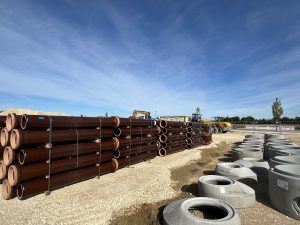
Below are six key benefits of vitrified clay pipes that make them an excellent choice for brownfield applications.
Resistant to chemical attacks
Brownfield soils can contain residues of industrial chemicals, fuels or solvents. Vitrified clay pipes are chemically inert, offering resistance to acids and aggressive ground conditions. This ensures the drainage system remains unaffected by the ground environment.
Extreme longevity
Unlike many alternative materials, vitrified clay pipes do not degrade or lose strength when exposed to such chemicals or to sewer gases like hydrogen sulphide. Their non-porous surface and rigidity prevent structural damage, which is a key factor in ensuring consistent and low-maintenance flow in underground systems.
With lifespans exceeding 150 years, VCPs can outlast surrounding infrastructure, making them a robust and low-risk option for contaminated sites where long-term reliability is essential.
High load-bearing capacity
Redeveloped urban sites frequently involve heavy traffic, variable ground conditions and deep installations. Vitrified clay pipes provide exceptional strength and load-bearing capacity, achieved through high-temperature vitrification of natural raw materials such as clay, chamotte and water. This process produces a dense and resilient pipe capable of withstanding static and dynamic loads.
The longitudinal compression resistance is as high as 100N/mm2, which makes them a compelling choice when long-term low maintenance is a priority.
Easy maintenance
Drainage systems on brownfields often face higher risks of infiltration and blockages. The smooth internal surface of vitrified clay pipes resists deposits and reduces friction. Their rigid structure allows for localised repairs in the ground, reducing the need for disruptive excavation, lowering the overall life cycle costs for managing drainage systems.
Environmentally friendly
Vitrified clay pipes are made entirely from natural raw materials and are fully recyclable, aligning with strict sustainability targets and circular economy principles. At least 30% recycled content is incorporated into production at Steinzeug-Keramo, ensuring environmental responsibility without compromising performance. Since they do not degrade, vitrified clay pipes can be recovered and reused, minimising the environmental impact and avoiding waste.
These pipes also do not contain any harmful substances or leach pollutants. Their inert ceramic body can be left in the ground without compromising soil or water quality, providing specifiers with confidence in meeting strict environmental standards for redevelopment.
Whole-life cost benefits
Although initial material costs can be higher than some alternatives, the low maintenance, long service life and reduced need for replacement make vitrified clay pipes highly cost-effective over the life of a project. On brownfield sites where repairs are especially challenging, this becomes a major advantage. A Life Cycle Costing study by the Ceramic Research Centre of Bologna found that if the operational lifespan exceeds 40 years, vitrified clay pipes are the best investment, offering cost savings of up to 65% in the long run compared to alternative materials.
Vitrified clay pipes are also particularly suitable in combined sewer systems and deep trench installations, where access and replacement are costly and disruptive. Their long lifespan, coupled with compatibility for trenchless installation and rehabilitation techniques, positions them as a forward-thinking solution for modern infrastructure projects.
For more information on Steinzeug-Keramo, visit: https://www.steinzeug-keramo.com/en-gb/
Read other recent news: https://industrial-compliance.co.uk/category/news/