Research by IBM and Oxford Economics has found that 86 per cent of companies have a sustainability strategy in their operations — but only 35 per cent have acted upon it. Are these companies overlooking the significant energy saving potential of industrial motors and drives? Here, Menno Kuipers, Business Development Manager – End Users Europe at WEG, Europe’s second-largest supplier of low-voltage electric motors, explains how energy-efficient motors and drives can help manufacturers significantly reduce their CO2 emissions.
The data from IBM and Oxford Economics emerges at a time when manufacturers face increasing pressure from stakeholders — including clients, staff, shareholders and collaborators — to prioritise sustainability within their corporate strategies. That includes the European Union’s Energy Efficiency Directive (EU EED), which requires manufacturers to undertake a high-quality energy audit every four years.
Fortunately, there are several ways in which manufacturers can implement process efficiency improvements and tackle the sustainability challenges head-on. Many of these improvements relate to the use of industrial drives and motors in manufacturing processes — let’s take a closer look.
Reducing energy consumption
The different international efficiency (IE) classes indicate how energy efficient a motor is based on its design, as defined by the International Electrotechnical Commission (IEC). For instance, WEG’s research indicates energy savings ranging from 2.1 to 12.4 per cent by transitioning from standard IE2 high efficiency to IE3 premium efficiency motors.
A manufacturer’s choice of energy-efficient motors and drives must also comply with relevant certifications and standards. WEG’s motors have long surpassed Commission Regulation (EU) 2019/1781 standards, with a range of motors rated at IE5 and beyond for industrial applications.
Newer models offer higher efficiency ratings and superior control mechanisms, enabling precise energy usage.
Higher efficiency with IE6
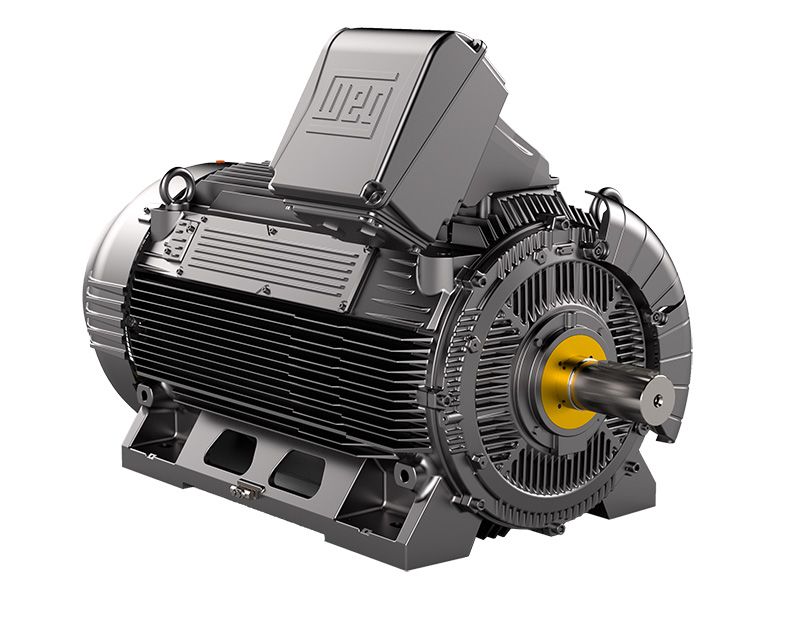
The W23 Sync+ is a hybrid innovation combining permanent magnet (PM), ferrite or neodymium magnets and synchronous reluctance (SynRM) motor technologies. W23 Sync+ motors meet the higher IE5 efficiency level while WEG’s flagship variety, known as the W23 Sync+ ULTRA, meets IE6. An IE6 motor has another 20 per cent reduction of losses compared to an IE5 motor.
WEG’s PMSynRM technology ensures a flat efficiency curve, boasting a higher level of efficiency for the entire speed range compared with conventional induction motors, as well as a higher power factor than normal synchronous reluctance motors.
This results in less energy usage and a lower total cost of ownership (TCO) for plant managers. The PMSynRM technology varies in the separation of electrical losses in the electric motor by employing magnets. The magnets generate their own magnetic field without requiring induction of currents. Therefore, they reduce the motor’s total losses.
But how do these advantages tie-in with reducing CO2 emissions? Specifically, the W23 Sync+ motor line unlocks energy savings that directly impact on facilities’ CO2 emissions. In fact, the WEG team has calculated that replacing an IE3 induction 75 kW 4 pole motor with an IE6 W23 Sync+ ULTRA may result in a reduction of 126 tons of CO2 during the motor’s expected lifetime of 25 years.
Variable speed drives (VSDs) and soft starters
The performance of industrial drives and motors can be further optimised through the use of soft starters or variable speed drives (VSDs) also known as variable frequency drives (VFDs). VSDs regulate power supply to the motor, controlling its speed and torque to match the motor speed with the load requirements, for maximum efficiency, while also helping safeguard equipment against potential damage from power spikes or surges. Using VSDs to regulate speed can also reduce energy consumption by up to 50 per cent in the case of parabolic applications — such as a pump or fan.
Energy-efficient motors and drives are essential assets for energy managers’ sustainability plans, especially in applications like compressors, pumps and fans. Let’s look at an example of how these technologies can help yield energy savings and reduce carbon emissions.
Improved operational efficiency
Orleplast is a prominent British company specialising in packaging and disposable plastic production. The manufacturer experienced notable improvements in efficiency and sustainability at its manufacturing facility in Santa Catarina by implementing WEG’s innovative W22 Permanent Magnet (W22 Magnet) electric motors — the predecessor to the W23 Sync+ (ULTRA).
The W22 Magnet motor features a permanent magnet design that effectively reduces operating temperatures. Its consistent torque output ensures steady productivity even during low-speed operations. By integrating magnets into the W22 motor, significant reductions in electrical losses and motor heat are achieved. Consequently, the motor delivers comparable power to traditional squirrel cage induction motors but with a more compact frame size.
Orleplast deployed multiple W22 Magnet motors ranging from 220 to 260kW, complemented by a WEG CFW11 VSD system to control the motor. A comprehensive energy performance assessment revealed substantial savings equivalent to 286,416 kWh/year, sufficient to power 85 households annually. Additionally, Orleplast realised a remarkable return on investment (ROI) within just 2.7 years.
In adopting WEG’s W22 Magnet motors alongside CFW11 VSDs, Orleplast significantly improved operational efficiency at its facility. This initiative resulted in an annual reduction of 36.2 tons of CO2 emissions, contributing positively to environmental sustainability.
WEG’s W22 Magnet and W23 Sync+ motor lines each show how reducing carbon emissions associated with industrial drives and motors should be integral to any manufacturer’s sustainability strategy. Because these technologies are central in powering plant operations, they can be key to helping manufacturers apply their sustainability strategies — so the 65 per cent of manufacturers cited in IBM and Oxford Economics’ research have an opportunity to tackle these sustainability challenges.
Looking for a partner to release the burden of improving energy efficiency and reducing CO2 emissions in your industrial operations? Visit the WEG website.
Read other recent news: https://industrial-compliance.co.uk/category/news/