

By Stefania Moruzzi, Business Development Manager, UK Industry & Machine Tools, Siemens Financial Services UK
Sustainability in manufacturing is not only a moral obligation but also a business priority that enhances efficiency. One survey of 420 global manufacturing leaders reveals that over 70% expect circular business solutions to increase their revenue by 2027, nearly two-thirds believe that these strategies will improve operational resilience, and over half anticipate cost savings even when accounting for high upfront investments. Companies are therefore adopting a long-term perspective, resisting the influence of current trends. As highlighted by one manufacturing association, ‘it is becoming increasingly clear that environmental responsibility is essential for long-term corporate survival.’
Another commentator notes “the increasingly clear connection between sustainability and business performance”, explaining that, “We’re seeing that initiatives that drive resilience and productivity, often naturally deliver environmental benefits. When companies optimise their processes to use less water, less energy and fewer materials, they’re simultaneously improving their environmental footprint and their bottom line. This alignment of environmental and economic imperatives is creating new opportunities for innovation and growth across industries.”
The volatility of international change does not diminish the reality that manufacturers want to increase production without incurring additional costs. Sustainability and savings are often interconnected – using less costs less. Sustainability gains bring cost savings, by reducing energy use, minimising raw materials usage and waste production, and reducing the consumption of other resources, such as water, catalysts and lubricants.
Where are machine builders focusing sustainability efforts?
To respond to demand from their manufacturing customers, machine builders globally are bringing sustainability features to the forefront of their marketing. An analysis of the world’s top 50 machine builders shows that energy efficiency (promoted by 77% of top machine makers) is the most widely published sustainability benefit. This is closely followed by productivity improvements associated with Industry 4.0, which 70% of machine builders claim can be achieved with the same or reduced resources.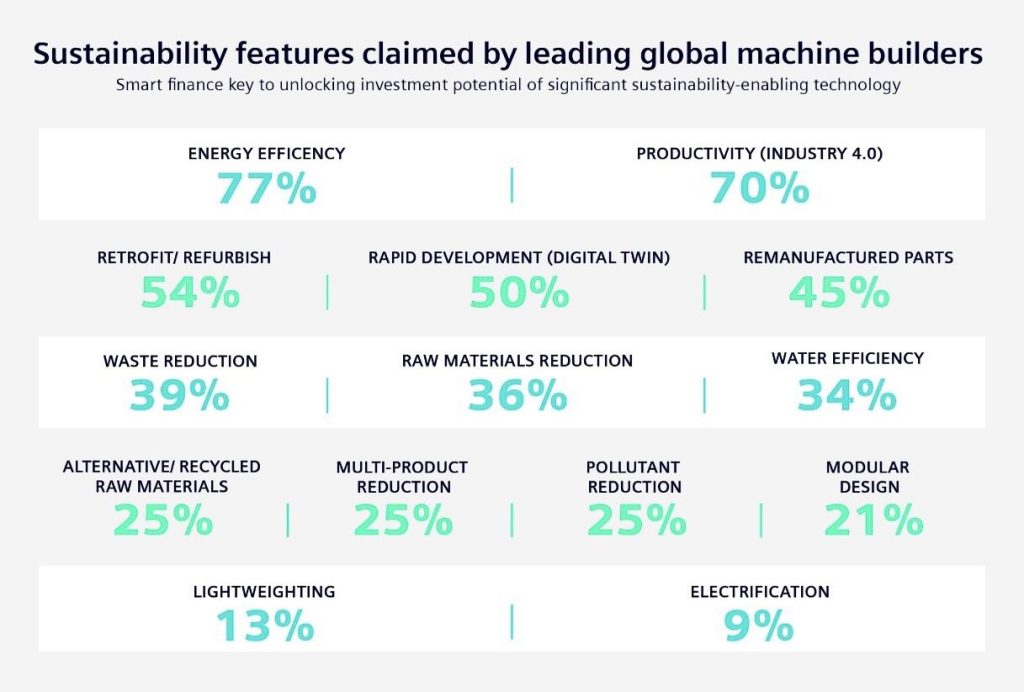
While this is certainly positive, what degree of savings influences manufacturers’ purchasing choices (beyond ethical and sustainability advantages)? Manufacturing equipment and solutions must also offer tangible cost savings to be a compelling business proposition, especially in an economic period challenged by input cost inflation, supply chain restructuring, elevated interest rates and more.
What are credible savings thresholds for manufacturers?
To find the answer, a research exercise commissioned by Siemens Financial Services, entitled Talking Sustainability, surveyed more than 100 machine builders globally. This study revealed that the average minimum energy savings from new generation industrial equipment exceeds 20%. While the ease of achieving these savings varies based on what a more sustainable machine replaces, most machine builders are confident that starting discussions with manufacturers can begin at the 20% mark.
Examples of savings and strengthened sustainability, enabled by equipment upgrades, abound.
- A vacuum pump vendor reports 33% reduced power consumption after deploying an energy-optimising dry pump upgrade for its customer – a semiconductor manufacturer company grappling with rising energy usage and expenses.
- A technology company shares how its machine vision software, partnered with a robotics solution and specialist camera equipment, helped an industrial bakery develop a conveyor tracking system that accurately picks bags of bread and rolls that come in multiple shapes and sizes. A lower error rate and higher throughput of goods lead to a 75% reduction in the overall costs compared to traditional camera and lighting options.
- A manufacturer of packaged consumer goods was generating food waste of 1.3% (actually thousands of kilos) at its German site, due to overfilled or underfilled packs being rejected. Thanks to new machinery, untouched food is hygienically removed and repackaged, while the original pack can be recycled – reducing waste by 55% and resulting in over €1.24 million net savings.
The examples above show how new generation equipment can have a transformational effect on efficiency, strengthening sustainability at the same time, through energy savings or reduced waste. This is not going unrecognised by manufacturers. A global survey of over 1,000 manufacturing professionals shows that robotics and automation tops technology investment priorities for over a third of respondents.
Automated solutions can also be refined and upgraded over time. As Unilever’s Global Head of Customer Operations, Juan Carlos Parada, explains, “We’ve been on a path to not just ‘do’ digital but rather ‘be’ digital. We’re moving into an environment where meaningful portions of the work are getting done by machines, guided by people. It’s a mindset shift that is leading to some real breakthrough thinking.”
What is blocking investment in sustainability-enabling technologies?
So it’s clearly worth investing in tech upgrades. However, digital transformation maturity is not widespread outside of larger manufacturing businesses. One survey found that just 25-30% of manufacturers had so far undergone ‘significant’ digital transformation, looking across all sizes of firm.
There are a few blockers to more widespread digitalisation: the need for management to understand return-on-investment, the challenge of managing and leveraging data, engaging employees in new systems, and a lack of knowledge sharing between the buy-side and supply-side.
More fundamentally, no transformation is possible without finance. But funds are tight in markets where economic performance is uncertain and where international geopolitics are increasing that uncertainty.
How can manufacturers take the leap and invest?
Flexible financing options – where manufacturers spread investment cost across an agreed period, aligning repayments with cash flow – are increasingly critical to manage external volatility. These options cover a variety of flexible financing structures, usually based on some form of lease finance.
Knowledgeable financing support is also vital. Implementation must be accompanied by strategy and careful planning, to avoid costly failure – a risk when companies don’t take the proper preparatory steps. A specialist financier will have deep sector experience – meaning that they understand the realities of technology applications and benefits, helping them to offer the most appropriate, individualised financing plan.
In sum, specialist finance allows manufacturers to affordably access the sustainability-enabling features promoted by over 75% of machine builders – strengthening efficiency and making savings, while also protecting working capital for other essential business needs. Regardless of regulation or policy that imposes sustainability targets, taking advantage of this pathway generates commercial benefits for manufacturers of machinery and technology, as well as the manufacturers purchasing these assets.
Broadbent embraces transformation using digital twin, enabled by CT Systems expertise, Siemens technology and smart financing from SFS
Thomas Broadbent commissioned CT Systems to implement a major retrofit of one the company’s critical machining centres by collaborating with Siemens and Siemens Financial Services (SFS). The project utilises digital twin technology to minimise interruption to the production schedule, and a tailored financing solution from SFS managed a smooth cash flow for all involved.
Chris Haigh is the Managing Director of CT Systems, a manufacturing technology integration and retrofit specialist based in Huddersfield, West Yorkshire, England. “Our game-changer was the availability of Siemens’ simulation and digital twin software. It completely changes the dynamics of upgrade and retrofit. We were able to structure the project in a revolutionary way. With the upfront costs managed through smart financing from Siemens Financial Services, this is helping us address more and more digital transformation projects like the leading one at Broadbent.
“First, we can develop the retrofit over some 18 months – all in the virtual world, all off-site, meaning there will be no disruption for Broadbent. We can plan everything in the digital twin, making the process as efficient as possible. Actual installation and final live testing will be compressed to a period of three to four weeks. Suddenly, this makes commercial sense for Broadbent, with the installation period reduced to a commercially acceptable period…The original machine can continue to do its job until the retrofit is designed, tested and finalised in the digital twin.”
Matthew Durkin-Jones is Finance Director of Thomas Broadbent & Sons Ltd, a leading manufacturer of centrifuges. “Innovation, automation, energy-efficiency and sustainability are all hallmarks of our machines operating in the field all over the world, so it seemed right that we chose a sustainable solution for the update of our Waldrich Coburg.
“The very definition of retrofit is sustainability – as we preserve all the good working parts of the original machine, only upgrading what is needed for full modernisation and digital transformation. By deploying the digital twin at CT Systems, sustainable goals are served through saving on physical materials and energy that would have been consumed during on-site development and testing. Then on top of that we get the sustainability benefits that digitalisation brings in terms of operational analysis, visibility from machine data and predictive interventions.”
Read more on this story here. Learn more about manufacturing finance here.
Read other recent news: https://industrial-compliance.co.uk/category/news/


