

In the demanding world of industrial finishing, safety and productivity are often viewed as opposing forces. However, by integrating process control with safety logic from ReeR Safety, there are examples where manufacturers can achieve high-speed throughput without compromising operator protection.
For a global leader in the design of integrated finishing lines for painting, decoration, and digital printing, quality and speed are both essential. Their systems operate in high-stakes environments where quality, repeatability, and production continuity are the primary benchmarks of success.
In these highly automated settings, the challenge is twofold: the system must precisely identify the geometry of workpieces to apply finishes accurately, while simultaneously protecting operators from the hazards of automated conveyors, spray jets, and processing stations.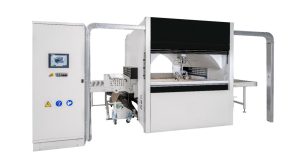
Beyond Parallel Tracks
Traditionally, process data acquisition and safety functions have operated on separate circuits. The machine designers sought to move away from this fragmented approach, looking for a solution that combined these functions into a single, cohesive architecture.
The requirement was clear: the system needed to manage real-time process data essential for optimising paint application while meeting the stringent requirements of EN ISO 13849-1, EN ISO 13855 and the Machinery Directive 2006/42/CE. The goal was to ensure that safety measures did not run on a “parallel track” to production but rather acted as an enabler of the process itself.
The Architecture of Integration
An integrated architecture was designed where measurement and protection work in tandem, coordinated by a central intelligence hub.
Precision Measurement: MICRON measurement light curtains:
ReeR MICRON measurement light curtains are used to acquire process data. These curtains detect the profile of panels as they move along the line in real-time. By reading the photodiodes, the system enables the PLC to reconstruct the part’s geometry and dynamically adjust the painting parameters.
Because this measurement is non-contact and performed in-line, quality control occurs at full production speed. For this application, the MICRON MI 1351 B with digital outputs was selected, offering:
- Controlled height: 1340 mm
- Beam spacing: 10 mm
- Max range: 10 m
Active Protection: EOS safety light curtains:
While the MICRON curtains handle the “eyes” of the process, ReeR EOS safety light curtains provide the “shield.” These monitor access to hazardous zones, triggering a safe stop only when an intrusion is detected. This “active” protection is designed to be surgical, intervening only when necessary to prevent nuisance trips that can plague less sophisticated lines.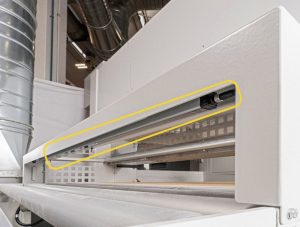
The specification for this application featured the EOS2 603 X safety light curtain:
- Safety Level: Type 2 – PL c
- Resolution: 30 mm
- Controlled height: 610 mm
- Max range 12 m
- Features: User-selectable automatic or manual restart
The Central Hub: MOSAIC M1S COM safety controller:
The “brain” connecting these two tiers is the MOSAIC safety controller. Rather than just “managing safety” it establishes a centralised control logic to which all devices communicate seamlessly.
Safety light curtains, sensors, and emergency stops are managed within a single architecture. This provides the machine builder with a flexible stop-and-restart logic adaptable to a variety of machine designs.
Furthermore, the M1S COM’s ethernet connectivity provides real-time status and diagnostics via the supervisory system. This reduces downtime significantly, allowing maintenance teams to quickly identify problems.
Safety as a Productivity Driver
These implementations challenge the old-fashioned trope that safety hampers performance. On these lines, the opposite is true.
By integrating the EOS safety light curtains, MICRON measurement, and the MOSAIC control, a machine design is created that protects high-risk areas, without interrupting the production flow.
If an emergency stop device is activated, this is managed by the controller to ensure safe stopping of all moving parts, including the most critical ones, whilst the information remains available for diagnostics. The result is not just a safer machine, but a more “aware” machine, where the system provides the diagnostic data needed to get back up and running fast.
Viewing the machine design as a whole system, integrating safety and process whilst following the principles of safe design according to EN ISO 12100, delivers a machine that reduces waste through more precise control, protects its workforce, and maintains the high-speed operational continuity.
In the modern factory, safety is no longer a constraint to be managed, it is a fundamental component of a high-performance process.
PLUS Automation is a representative and importer for ReeR Safety in the UK, and aims to help engineers #MakeSenseofSensors and #MakeSenseofSafety.
Read other recent news: https://industrial-compliance.co.uk/category/news/


