In this Q&A with Industrial Compliance, Pepperl+Fuchs discusses how its Tab-Ex intrinsically safe tablets help maintenance teams improve communication, digital workflows and worker safety in hazardous industrial environments.
Q: Could you introduce the Tab-Ex intrinsically safe tablets and explain their role in digital workflows within hazardous industrial environments?
For workers in hazardous industrial environments, it is imperative that their work equipment addresses their specific needs and wants. With the Tab-Ex tablet family from Pepperl+Fuchs the goal is to offer these mobile workers the best support possible. To ensure digital workflows are running smoothly even in remote industrial areas, the tablets support all up to date modern communication standards.
The technical specifications of the latest version Tab-Ex 05 in combination with 5G enables the use of Augmented Reality (AR), contacting remote support in real-time, or reliably call for help in case of an emergency. Since remote workers are often required to wear work gloves, the tablets also feature Glove Mode and an S Pen stylus, so they can be used reliably even when wearing gloves.
Q: What were the key design priorities when developing the Tab-Ex 03 for use in potentially explosive atmospheres?
The tablets of our Tab-Ex series first and foremost must be intrinsically safe, so as not to pose an ignition source in hazardous areas. At the same time, they must address the users’ needs. The multitouch display can be operated with S Pen and with gloves and offers optimal readability even in direct light. From indoor applications to harsh environments, the Tab-Ex is designed for use in hazardous areas and a wide range of industrial applications.
Q: Safety certification is critical for intrinsically safe tablets. Can you explain the ATEX and IECEx approvals the device carries?
ATEX and IECEx both address equipment for use in potentially explosive atmospheres, but they differ in scope and legal status. ATEX is the European regulatory framework and is mandatory for products placed on the EU market, while IECEx is an international certification system based on IEC standards that facilitates acceptance in many countries outside the EU.
The intrinsically safe tablets of our Tab-Ex series are all approved according to ATEX and IECEx standards and internationally certified for worldwide use in hazardous areas, including Zone 1/21, Zone 2/22, Class I, Division 1, and Class II, Division 2. Additionally, the Android Enterprise Recommended seal and the Android Enterprise Silver partner badge guarantee that the latest version, the Tab-Ex 05, will be supported with regular security updates until 2032 and OS updates up to Android 22 and carries a Common Criteria certification.
Q: Many maintenance tasks are carried out in harsh environments. How does the device perform in terms of durability, temperature tolerance, vibration resistance and operation with gloves?
The Tab-Ex series is certified according to the military standard MIL-STD-810H, meaning they have been tested and certified for use under rough conditions, including vibration resistance. The operating temperature is specified from -20°C to +55°C. To ensure the tablets can be reliably used with gloves, they feature a specific Glove Mode, which increases the touch screen’s sensitivity.
Q: Connectivity is often limited in refineries and chemical plants. How does the Tab-Ex ensure reliable communication with sensors and instrumentation systems in these environments?
Limited connectivity is one of the most critical challenges in refineries and chemical plants. Hence many operators are implementing private campus networks, which also enable network slicing, e.g. with one slice for critical communication and secured bandwidth in an emergency. The Tab-Ex supports this standard to ensure reliable communication even in remote areas of a refinery or plant.
Q: Data capture and documentation are becoming increasingly important for maintenance and compliance. How do Tab-Ex intrinsically safe tablets support digital documentation, reporting and asset management?
To support digital documentation, reporting, and asset management, our Tab-Ex tablets are equipped with powerful front and back cameras to take high-resolution pictures or record Full-HD videos. 128 GB of internal memory that can be extended up to 1 TB via micro-SD card ensures that all relevant data is securely stored for any documentation purposes. Support for 5G in our latest tablets ensures that data can be transferred to the network immediately after capture, to prevent any delays or human forgetfulness at the end of a shift.
Q: Battery life is a key concern for field technicians. What steps have been taken to ensure the Tab-Ex 03 delivers reliable operation throughout a full maintenance shift?
The Tab-Ex 03 is equipped with a 5,050 mAh battery with up to eleven hours of runtime, which is enough to last for a full maintenance shift. We placed strong emphasis on battery optimisation and battery life for a full shift right from the specifications phase and throughout development.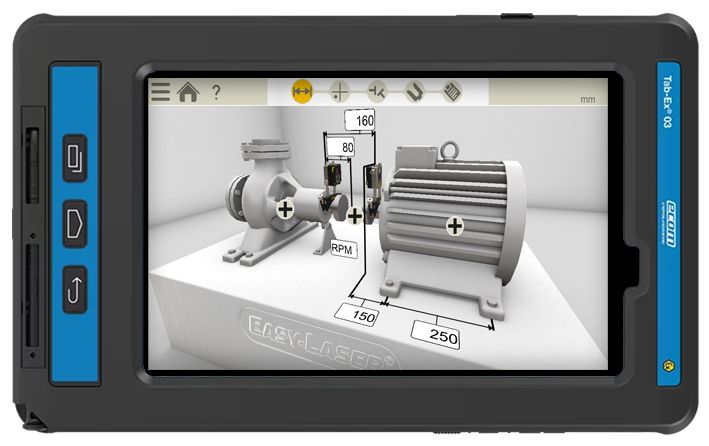
Q: From your experience working with customers, what productivity gains can maintenance teams expect when adopting rugged, intrinsically safe mobile devices?
First and foremost, they can be sure that their electronic device has been certified as not constituting an ignition source – either through sparking or through impermissible heating. Additionally, they fulfil further criteria, such as robustness for field use, a large, bright display that is easy to read even in direct sunlight, and reliable operability with gloves or the S Pen.
The productivity gains for maintenance teams come less from one single feature and more from the way rugged, intrinsically safe mobile devices combine communication, safety and digital workflows in one platform.
With Push-to-Talk over IP, teams can replace or extend traditional radio-style communication with individual, group, priority, emergency and broadcast calls over existing Wi-Fi or public cellular networks, without the need for separate communication infrastructure. At the same time, these devices support integration with existing PMR and even TETRA environments, which helps maintenance teams coordinate faster, reduce response times and keep experts, supervisors and technicians aligned across shifts, sites and regions.
An equally important productivity driver is Lone Worker Protection, because safety and efficiency go hand in hand in hazardous areas. We combine intrinsically safe mobile devices with functions such as motion-based alarms, dead man’s switch, SOS triggering, geo zones, location-based services and data exchange between the control centre and the end user. This means one device can support both day-to-day maintenance communication and personal safety, enabling more tasks to be carried out by individual workers while still maintaining a high level of protection.
In addition, features such as a desktop mode extend the device beyond the field: users can connect to a monitor, keyboard and mouse and handle documentation, spreadsheets or reporting in a desktop-like environment, reducing device changes and helping teams move more seamlessly from inspection to follow-up work.
Additionally, it stores data including photos taken with the integrated cameras, which deliver high image quality even in poor lighting conditions and are capable of facial recognition and scanning barcodes and QR codes. Reports can be created directly on the tablet during an assignment. It can connect to sensor units via Bluetooth, which is vital as Wi-Fi is not available in many plants or is disabled for safety reasons. Our global logistics and technical support ensure that replacement parts and devices are available at short notice. They are also available and maintainable for several years, ensuring long-term predictability.
Q: Which industries are seeing the strongest adoption of intrinsically safe tablets, and what are the most common use cases?
We see the strongest adoption of intrinsically safe devices in industries that often deal with hazardous environments. This applies to oil and gas, pharma and petro-chemical, hydrogen, or mining. The most common use cases are digitalisation initiatives, predictive maintenance, and everyday field work of deskless workers.
But we also expand our product portfolio to industrial-grade tablets for use in harsh and non-Ex environments. The light and compact Tab-IND devices with enterprise durability and ruggedisation are available for Windows and Android. The optional Scanner Frame extends the range of applications to logistics, warehousing and asset tracking.
Q: Looking ahead, how do you see mobile computing evolving in hazardous industrial environments?
Intrinsically safe tablets and smartphones already serve as digital and networked hubs for connected workers. They enable authentication, collect sensor data, and bundle a wide variety of communication channels. They also allow for the seamless integration of mobile scanners, IoT gateways, or communication peripherals such as headsets. This makes them a central component for safe, efficient, and networked work processes in hazardous areas.
In the future, platforms for “digital shift operation” will emerge that digitally map handover protocols, know-how transfers, shift handovers, and shift KPIs, thus enabling comprehensive shift digitalisation. Step by step, the connected worker is evolving into a highly networked, smart-supported employee who can access and respond to all relevant information, analysis tools, and expert knowledge securely and context-sensitively in real time at any time.
In our view, Augmented Reality will also provide even greater support to mobile workers in their daily tasks. It enables all existing data of a plant or machine to be displayed on the mobile device in real time. This saves time, leads to fast response times and ensures precise maintenance and inspection of industrial objects. AR provides all significant technical data on mobile devices in real time. The mobile device uses sensors to detect the object and the software then displays all relevant technical data. Productivity, efficiency, flexibility and plant safety can be increased by means of a smartphone or tablet with AR application.
Read other recent news: https://industrial-compliance.co.uk/category/news/