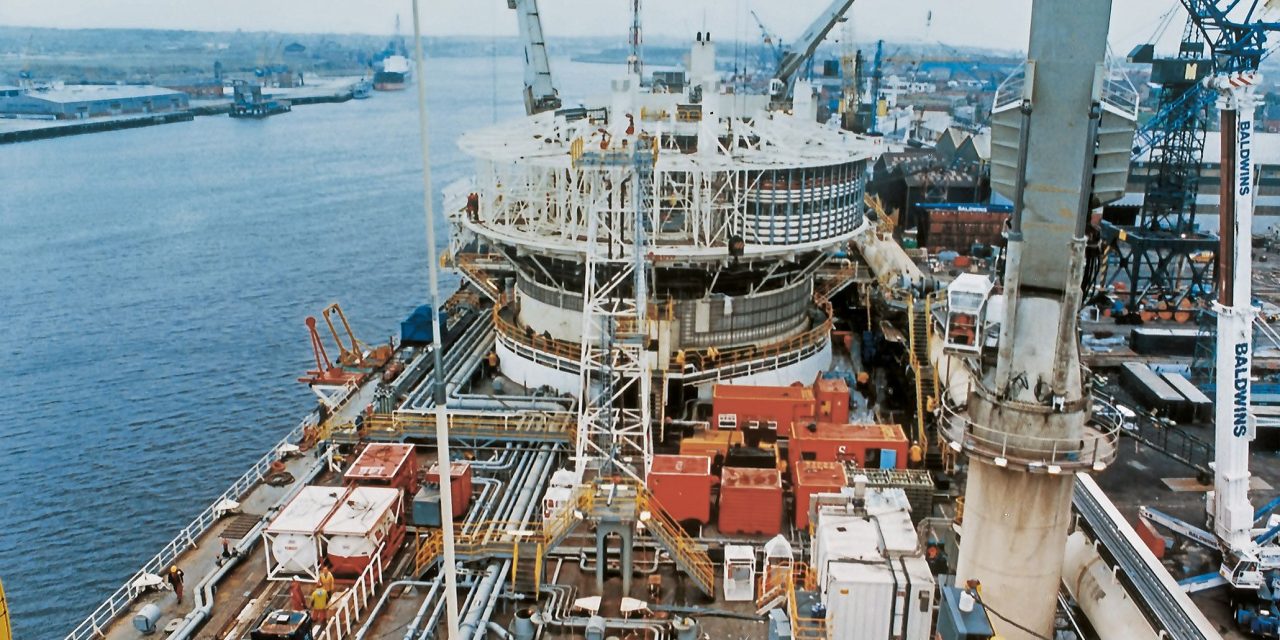
Offshore plants run in extreme conditions. Wind, waves, corrosion and highly dynamic movements put the systems involved to the test around the clock. TSUBAKI KABELSCHLEPP is meeting these challenges with decades of engineering expertise and a portfolio of offshore cable carriers that can be tailored precisely to these challenging conditions.
Offshore cable carriers have a critical safety function on oil rigs, on production vessels and in maritime handling facilities. They reliably carry energy, data and media even in the most difficult conditions, including in top-drive systems, crane systems, thruster systems, winches or pipe handling. Unplanned downtime has substantial economic and safety implications, particularly in offshore environments.
The requirements for offshore cable carriers are as varied as the applications themselves. Different motion profiles, high additional loads and complex kinematics are made even more difficult by restricted installation spaces. This is further compounded by dynamic forces due to continuous platform movements in all three axes. TSUBAKI KABELSCHLEPP develops individual solutions for these applications, from unsupported or gliding systems to roller carriers for extended travel lengths or circular arrangements in rotating applications. Metool Products Ltd, a KABELSCHLEPP subsidiary, serves as the industry partner for the UK market. With decades of experience in the offshore sector, the company has supplied cable management systems for hundreds of offshore projects.
The selection of materials for offshore cable carriers is particularly important. All components are permanently exposed to salty air, UV radiation, wind, sea spray and strong temperature fluctuations. TSUBAKI KABELSCHLEPP therefore selects materials for the specific applications, such as A4-grade stainless steel, seawater-resistant aluminium alloys and special technical plastics for underwater applications.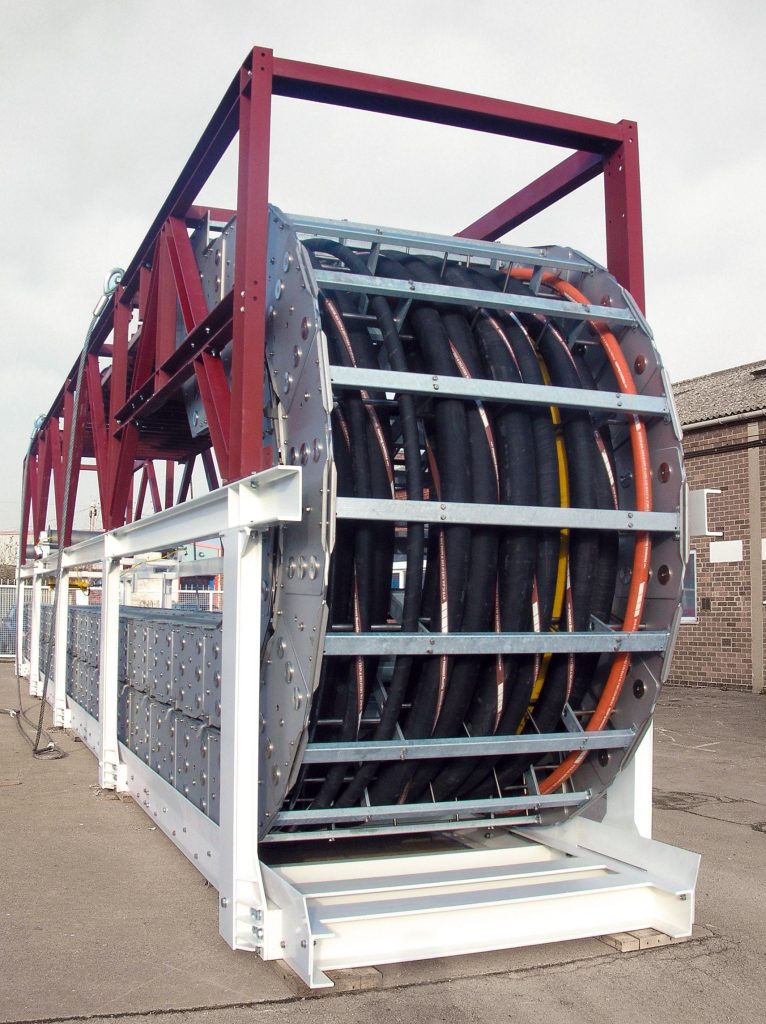
Comprehensive factory acceptance tests
The highest safety standards also apply to the design of offshore cable carriers. Secured threaded connections, redundant fastening and comprehensive factory acceptance tests (FATs) are part of all projects. In addition, the cable carrier systems are designed for optimum protection during transport to the offshore plant. The special transport frames subsequently become an integral component of the final structure.
In addition to mechanical and climatic effects, a number of international directives and standards have to be taken into account, depending on the plant type and location. All development work at TSUBAKI KABELSCHLEPP is therefore based on close cooperation with the customer, and each project focuses on the specific application at hand.
Condition monitoring for offshore cable carriers gains importance
Durability and robustness play a crucial role in the design of offshore plants. As there are limitations to how accurately the loads can be predicted, TSUBAKI KABELSCHLEPP deliberately takes a conservative approach to configuring offshore cable carriers and applies the highest safety factors. Additionally, condition monitoring is becoming increasingly important to identify load changes early on and to plan condition-based maintenance.
“More than 70 years ago, we invented the steel cable carrier,” Jürgen Weichel, industry manager at TSUBAKI KABELSCHLEPP, summarises. “Based on these decades of experience, we can now derive a suitable solution for any application from a very broad portfolio. Our colleagues have a vast store of knowledge and are particularly strong in the development of customised solutions, which are par for the course when it comes to offshore plants.”
Read other recent news: https://industrial-compliance.co.uk/category/news/