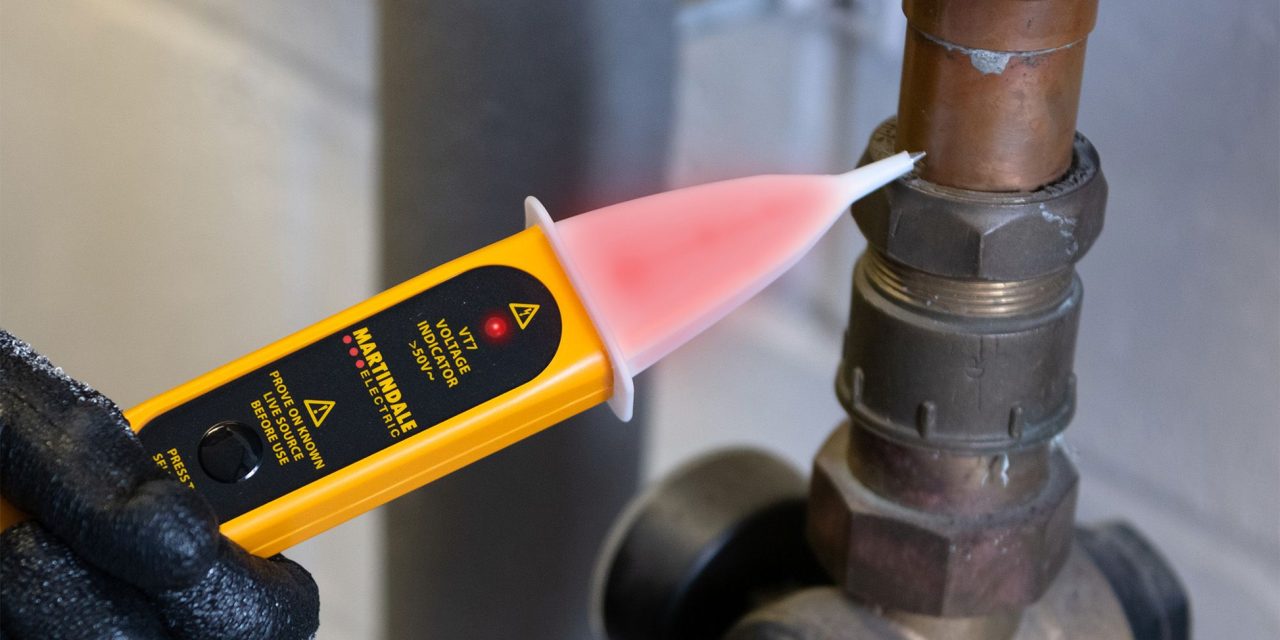
Checking the touch voltage on metalwork is an essential safety action before work commences, yet injuries still occur through contact with unexpectedly live metal parts.
A recent survey conducted by Martindale Electric indicates that approximately 40 per cent of electrical workers have encountered metalwork that was unexpectedly live. This includes metal casings on equipment, pipework, plumbing and other metal parts that should be earthed. The survey also revealed that many electrical workers do not regularly use a tester to check touch voltage on metalwork.
Several types of fault can cause this potentially dangerous issue, including incorrect or hazardous wiring, trapped cables and protective earth and neutral (PEN) faults.
Checking for touch voltage
A single-pole contact voltage detector such as the Martindale VT7 can be used to check for live metalwork. The VT7 is GS38 compliant and provides a fast solution for touch testing on exposed metalwork.
The VT7 detects AC voltages from 50 V to 600 V, with audible and bright LED indication. Its durable, ergonomic design makes it suitable for domestic, industrial and utility applications. The unit has a self-test function, is IP54-rated for indoor and outdoor use and can also be used while wearing protective gloves and gauntlets.
“Non-contact voltage detectors are often used in this application but should always be used with caution as they can be, and often are, sensitive to other signals such as static electricity,” explains Steve Dunning, managing director of Martindale Electric. “The lower detection threshold for the VT7 helps ensure that unsafe voltages can actually be detected, because non-contact detectors can have a much higher threshold.”
Single-pole contact indicators offer a simple, low-cost addition to an electrical worker’s toolkit to help identify potential issues.
For further information, visit Martindale Electric.
Read other recent news: https://industrial-compliance.co.uk/category/news/