
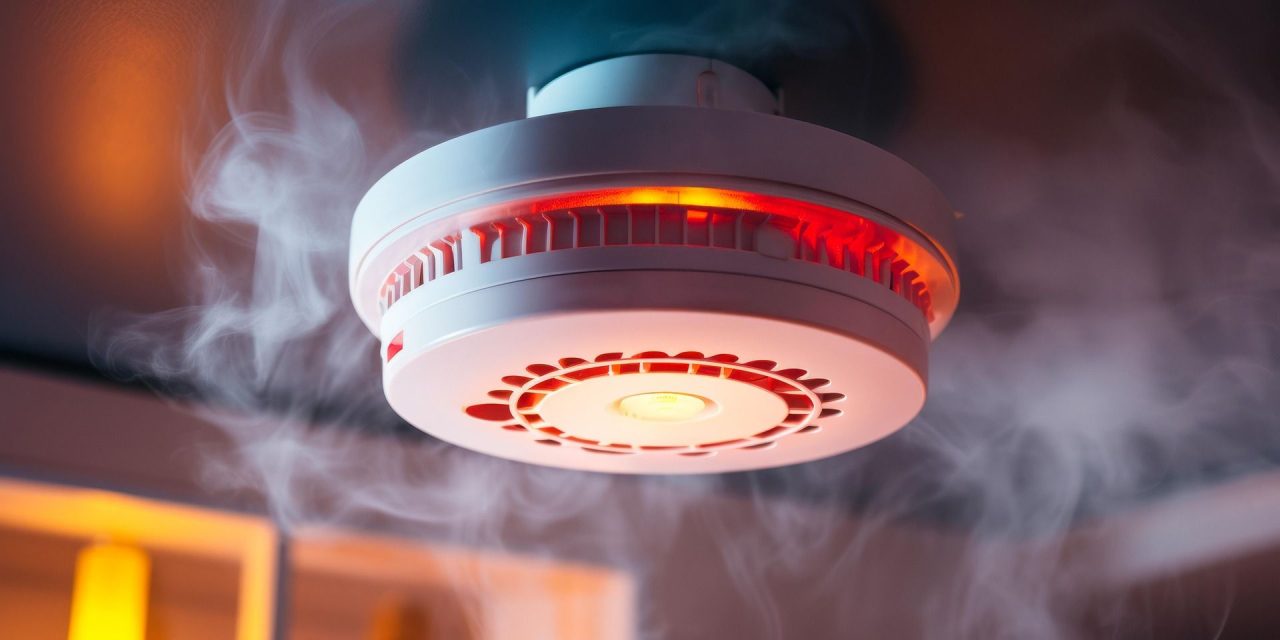
In the event of a fire, smoke detectors are the first line of defence. But the economics of smoke alarms are shaped by a simple truth: these are lifesafety devices produced at scale, where reliability, compliance and cost all matter at the same time. Here, Ross Turnbull, Director of Business Development at application specific integrated circuit (ASIC) specialist Swindon Silicon Systems, presents the commercial case for custom ICs for smoke detectors.
The UK Government’s Fire Kills campaign highlights that each year in England, fire kills around 200 people in the home, reinforcing why fire detection is a national priority.
But it also highlights a limitation that strongly influences installation practice and system design: “in more than a third of home fires, smoke did not reach a smoke alarm in time to raise the alert”, which is why the campaign urges households to install more alarms in more places and notes that some alarms can be interlinked so that when one activates, all sound together.
Sensor safety
Fire Kills makes clear that sensor safety is not just about the sensing mechanism, but about whether an alert is raised in time for occupants to respond. It is fundamentally a coverage problem, which matters commercially for smoke detector manufacturers because improved coverage often means more devices per property, higher expectations of consistent behaviour across units and greater scrutiny of reliability and maintenance over long service lives.
Nuisance alarms are where safety and economics overlap most visibly. Nuisance alarms, which are often triggered by cooking smoke, shower steam and aerosols, can lead to consumers disabling units, presenting a key design challenge for manufacturers.
Connected safety
The combination of interlinking and connected behaviour is a direct response to the coverage challenge.
Regulation reinforces this direction in parts of the UK. In Scotland, the law requires homes to have interlinked smoke and heat alarms, which normalises interconnected detection as a baseline expectation rather than an optional upgrade.
Connected systems change what good looks like commercially. Multidevice systems are judged on consistent behaviour across devices, resilience to nuisance triggers and clear fault reporting over time, which increases the importance of lowpower operation and dependable selfchecking.
But connected systems also raise the cost of complexity. If each connectivity tier requires different electronics and a separate validation pathway, manufacturers increasingly benefit from platform approaches that scale across a product family without multiplying hardware variants and production risk.
The ASIC solution
This is where application specific integrated circuits (ASICs) earn their place. ASICs are custom-designed integrated circuits (ICs), built to implement a narrowly defined set of functions with maximal efficiency. By hardwiring only what the product needs, they deliver compelling advantages at scale.
ASICs don’t change the physics of detection or create coverage. But they do strip cost and complexity out of building compliant products in volume. In a category where margins are tight and deployments are large, that’s the win.
By integrating the optical frontend, LED drivers and analogue-to-digital converter (ADC) on a single die, multiple discrete parts collapse into one qualified component. This reduces placements and solder joints, shrinks board area and simplifies procurement. It also facilitates an ultralowpower design, allowing for longer battery life without resorting to larger cells, helping manufacturers to maintain a consistent bill of materials even as features grow.
If global fire alarm deployments are indeed more than 72 million units per year, even small reductions in parts count or test seconds can translate into meaningful throughput and cost improvements across production runs. As manufacturers face relentless cost pressure and the escalating cost of complexity in parts, test, calibration and aftersales, ASICs are best understood as a commercial tool: enabling a platform that delivers more consistent products at the volume and price point that the market demands.
Swindon Silicon Systems has experience designing and supplying ASICs for smoke detector manufacturers. If you’re working on a project that could benefit from an ASIC, contact us today.
Read other recent news: https://industrial-compliance.co.uk/category/news/


