

Renewable energy consultancy Ennovus Solutions has launched a new solar panel savings calculator, designed to give businesses a better understanding of the benefits and cost-savings associated with solar energy investments.
By inputting key details about a building and its current energy usage, the free solar calculator provides a personalised report detailing projected savings, energy output, grid offsetting, estimated payback period and more.
The tool’s calculations are driven by the Microgeneration Certification Scheme’s (MCS) methodology and look-up tables for expected solar yield. MCS is the UK’s main accreditation scheme and quality mark for small-scale renewable generation, providing a streamlined and consistent calculation methodology.
Most commercial solar panel systems have a lifespan of 25+ years and an average payback period of four to six years, meaning that solar energy can help to reduce electricity bills, improve energy resilience and demonstrate a long-term commitment to environmental responsibility.
David Woon, head of net zero engineering and operations at Ennovus Solutions, said: “Recent geopolitical tensions have catapulted energy prices into international headlines, making it clear that a reliance on volatile energy markets is a huge risk for businesses.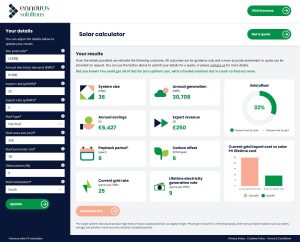
“Generating solar electricity on-site is a major opportunity for firms looking to reduce this reliance and protect against rising utility prices, but we often find that customers aren’t sure what that means for their business, or what information is required to make a start.”
The solar calculator creates a personalised report based on the following details:
- Import rate (p/kWh) – the amount you pay in pence for your current electricity supply, found on previous bills or your energy contact
- Export rate (p/kWh) – the assumed rate paid for exported electricity in pence per kilowatt hour, which can be inputted as 5p/kWh if unknown
- Your annual electricity demand – the amount of electricity you use per year, estimated in kWh, usually found on your previous bills or energy contact
- Roof type – does your building have a flat, pitched, or low-profile metal roof?
- Roof perimeter and size – this is usually in your building plan. If not, use a digital satellite tool like Google Maps. First, find your site, then right click and select ‘Measure Distance’. Draw around the edge of the area, and a box will appear at the bottom of the screen with your area size
- Any potential obstructions – this refers to the estimated percentage of your roof taken up by obstructions such as skylights, satellite dishes and chimneys
- Details for us to send your report to – your name, phone number and email address so that we can contact you about your results
David continued: “Our team developed this tool to make it easy for businesses to understand just how much of an impact solar panels can have – on operating costs, carbon emissions and ultimately, the bottom line. As well as providing resilience, investing in solar also signals to customers, investors and stakeholders that a business is fully committed to sustainable practices, which is essential in today’s economy. With fully funded solutions available, solar energy really is a no-brainer.”
The report includes the information below, giving businesses a deep insight into the benefits that solar provides:
- System size – an estimated solar PV system size based on your available roof space and current electricity usage, helping you understand the ideal set-up for your property
- Annual generation – an estimate of how much electricity your solar system could generate each year
- Export revenue – an estimate of the income you could receive by exporting unused electricity back to the grid through available export tariffs
- Payback period – an estimate of how long it could take for your energy savings to cover the initial installation cost of your solar system
- Carbon offset – the estimated reduction in carbon emissions your solar system could achieve each year
- Grid offset – a breakdown of how much of your electricity usage could be covered by solar energy
- Current grid import cost vs solar PV lifetime cost – a comparison between your projected future grid electricity rate versus the rate you could be paying over the lifetime of your solar PV system
- Lifetime electricity generation rate – an estimate of how much electricity your solar system could generate over its entire lifespan
Funding is available for solar panel installations through a range of models – including power purchase agreements and asset finance structures – allowing businesses to install solar with no upfront capital expenditure, aligning repayments with energy savings from day one.
To find out how installing solar could benefit your business, visit: https://solar-calculator.ennovus.co.uk/
For more information and support on renewable energy installation and management, visit: https://ennovus.co.uk/
Read other recent news: https://industrial-compliance.co.uk/category/news/


