Understanding how your business uses energy is essential for controlling operating costs and improving efficiency. That is where energy monitoring systems come in. By collecting accurate readings from meters and connected equipment, businesses can track usage, identify unusual patterns and make better-informed decisions about their operations.
This guide explains what an industrial energy monitoring system is, how industrial energy monitoring systems work, the benefits of smart metering and how to choose and implement an energy monitoring system for your site.
Key Takeaways From This Article:
- Industrial energy monitoring systems give you complete operational visibility by turning complex electrical data into straightforward, actionable insights
- Facilities cut immediate energy costs quickly by spotting hidden standby loads, unusual usage patterns and sudden demand spikes.
- Continuous energy tracking protects equipment health by flagging overloaded motors and worn pumps before costly downtime happens
- Automated, audit-ready data simplifies your SECR, ESOS and ISO 50001 compliance as well as ESG reporting
- Industrial edge gateways like PowTechnology’s Metron5 and MetronM easily retrofit into your existing assets and legacy equipment
What Is An Energy Monitoring System?
An Energy Monitoring System (EMS) is an integrated framework of smart meters, sensors, telemetry gateways and software designed to collect, transmit and analyse how much energy your site uses as well as where and when. It gives you complete visibility over your energy consumption.
Traditional meter readings provide a snapshot of energy usage at a particular time. Connected smart metering solutions offer a more detailed picture by collecting readings at regular intervals and making the information available through monitoring software.
For example, a manufacturer might use smart meters to compare electricity consumption across several production lines. Instead of seeing only the factory’s total usage, the operations team can investigate which areas consume the most energy and when demand peaks occur.
This makes it easier to identify unnecessary energy use, investigate unexpected consumption and assess whether operational changes are making a difference.
How Do Industrial Energy Monitoring Systems Work?
Industrial energy monitoring systems combine measurement hardware, communications technology and software to collect and present useful energy data. The exact setup depends on the application, but the process generally involves four stages.
- Measure Energy Consumption
Smart meters collect readings from electrical systems and connected equipment. Depending on the meter and its configuration, these may include energy consumption, power demand, voltage, current and other electrical measurements. You can install meters at different points across your site to understand overall consumption or focus on specific equipment that needs closer monitoring.
- Transmit The Data
Industrial Internet of Things (IIoT) gateways collect information from compatible meters, programmable logic controllers (PLCs), drives and other industrial equipment. They then transmit the data using suitable wired or wireless communications. eg) PowTechnology’s MetronM IIoT gateway uses RS485 Modbus RTU to collect readings from compatible devices and sends the information to the MetronView platform.
- Analyse
Monitoring software turns meter readings into information, such as dashboards, graphs and historical records that helps teams compare consumption over time, identify unusual patterns and understand how energy demand changes throughout the day. You can also configure alerts to notify relevant staff when readings exceed set thresholds. This helps teams investigate potential problems without relying entirely on manual checks.
- Optimise
Operational teams use these analytics to fix energy leaks, flatten peak demand, schedule predictive maintenance and verify energy bills. By continuing to monitor energy usage, businesses can assess whether any fixes have worked and identify further opportunities to improve performance.
Key Benefits Of Smart Metering Solutions
Smart metering helps businesses understand their energy consumption in greater detail. When combined with monitoring software and a clear plan for using the data, it can support better cost control, more efficient operations and improved reporting.
- Spot Energy Waste Quickly
Clear visibility helps you quickly find abnormal consumption patterns, equipment running unnecessarily, hidden energy drains and excessive standby loads. These are often quick wins that cost little to fix once identified.
- Reduce Energy Costs
When consumption becomes measurable, you can see exactly where real savings can be made. Many industrial tariffs penalise high peak demand and smart metering shows when peaks occur and what causes them, so you can stagger start-up sequences or shift loads to flatten them.
- Verify Supplier Bills
Comparing actual usage against supplier invoices helps you identify estimated readings, billing discrepancies and unexpected consumption. Understanding when and where inefficiencies occur also helps you uncover avoidable charges that often go unnoticed.
- Monitor Power Quality
Tracking voltage, current, power factor and load conditions gives you insight into how your electrical system is performing and helps you spot issues that may affect efficiency and equipment reliability.
- Simplify Compliance
Automated, audit-ready data collection streamlines regulatory reporting and supports your sustainability goals. Smart metering solutions support:
- SECR (Streamlined Energy and Carbon Reporting)
- ESOS (Energy Savings Opportunity Scheme)
- ISO 50001 energy management baseline establishment
- Identify Failing Assets
Energy data is also machine health data. A motor drawing more current than usual or a pump behaving differently at the same load, can be an early sign of wear. Combined with vibration and temperature monitoring, this feeds directly into remote condition monitoring and helps reduce unplanned downtime.
What Can Smart Meters Measure?
Selecting the right measurements ensures your system delivers relevant insights based on whether your priority is cost management, electrical power quality or machine reliability.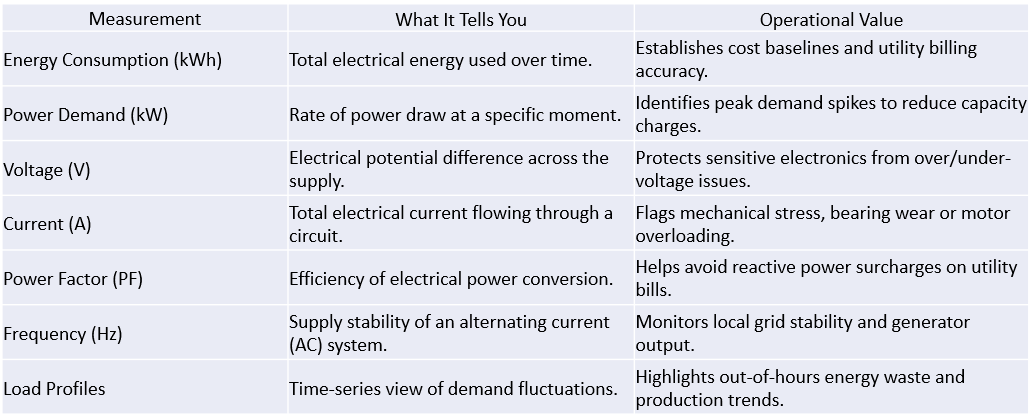
Key Components Of An Industrial Energy Monitoring System
An end-to-end industrial EMS relies on a robust hardware and software ecosystem:
Smart Meters And Sensors
Capturing raw operational data requires targeted hardware. With energy monitoring systems that means smart meters at the main incomer, on major machines and on sub-circuits. However, energy is not just electricity. Flow sensors for gas, water and steam, temperature and pressure sensors for process conditions and level sensors for fuel and tanks all provide a complete environmental picture.
IIoT Gateways And Data Loggers
Gateways collect data from meters and sensors and send it securely to a central platform. They are the bridge between your operational technology on the plant floor and your data systems. The Metron5 IIoT Sensor Gateway is designed for exactly this role and can be retrofitted to existing sensors.
Communications
Data can travel over wired connections, GSM (2G/4G/LTE) or LoRa, depending on the site. Cellular and LoRa connectivity are especially useful for remote or hard-to-access assets or where you do not want to rely on the site’s IT network.
Software And Dashboards
The platform turns raw readings into something people can act on: live dashboards, trend analysis, alarms and scheduled reports. MetronView gives you visibility of assets across multiple sites in one place, while the Siemens Insights Hub is available for sites already invested in the Siemens ecosystem.
Industry Use Cases
Smart metering can support a wide range of industrial and commercial applications. The most suitable approach depends on your equipment, energy requirements and operational priorities.
- Manufacturing plants – Monitor consumption across production lines, motors, pumps and machinery to identify inefficiencies and compare performance
- Warehouses and industrial buildings – Track energy usage across different areas and investigate consumption outside normal operating hours
- Data centres – Monitor electrical loads and support visibility over power systems serving critical equipment
- Utilities and pumping stations – Track electricity consumption alongside operational data to help assess equipment performance
- Power generation facilities – Monitor relevant electrical measurements and combine them with information from generators and backup systems
- Process industries – Understand energy demand across different processes
How to Choose the Right Smart Metering Solution
Choosing a smart metering solution starts with understanding what you need to measure and how you’ll use the information. The right system should work with your existing infrastructure and provide data that supports your operational objectives.
For example, a warehouse operator could use smart meters to monitor energy consumption from lighting, heating and refrigeration systems. A facilities manager could use the same principle to compare usage between buildings or identify unexpected demand overnight.
The important thing is to measure energy at the points where the information will help you make better decisions. When evaluating energy monitoring platforms, here is what to consider:
- Compatibility – Can it work with your existing sensors, meters and control systems?
- Scalability – Can you start with one meter or line and grow to multiple sites?
- Installation – How quick is it to install and commission and will it disrupt production?
- Connectivity – Does it support wired, GSM or LoRa where you need it?
- Cybersecurity – Is the supplier credible on security? Look for recognised accreditations such as ISO 27001
- Reporting and analytics – Can you build the dashboards and reports you actually need?
- Support – Who installs, maintains and supports the system after go-live?
PowTechnology supports industrial applications with smart metering, connected devices and remote monitoring technology. Explore our power and energy monitoring solutions for applications where electrical performance and reliable operation are essential.
How To Implement Smart Metering And Energy Monitoring
Introducing smart metering doesn’t have to mean monitoring every machine from day one. Starting with a specific objective can make implementation more straightforward and help you demonstrate the value of better energy data. Follow these steps to get started:
- Review your current energy data – Look at existing meter readings, electricity bills and operating schedules to understand what you already know about consumption
- Identify where better visibility would help – Choose the equipment, processes or areas where monitoring could answer an important question or help investigate a recurring problem
- Select the right meters and hardware – Determine which measurements you need and how the data will be collected from your existing infrastructure
- Connect your monitoring platform – Configure the system to collect and display readings at suitable intervals
- Set up dashboards and alerts – Make sure the right people can access the data and receive notifications when readings exceed agreed thresholds
- Review the results and identify improvements – Use the information to investigate energy waste, assess changes and decide whether to extend monitoring to other areas
Throughout the process, consider energy readings alongside production levels, operating schedules and other relevant information. This helps you understand why consumption changes and whether an apparent inefficiency requires further investigation.
Common Challenges And How To Avoid Them
It’s common to experience teething problems when rolling out an energy monitoring system. Knowing what to look out for helps ensure a smooth implementation and gets you the best results right from the start. Here are some common issues to be aware of:
- Data overload with no action – Dashboards full of numbers do not save money. Define KPIs and alerts up front, so the system tells you what needs attention.
- Poor meter placement – Metering the wrong point gives misleading data. Start with a review and prioritise your biggest loads.
- Lack of buy-in from operations – Involve production and maintenance teams early and show them how the data makes their jobs easier.
- Legacy equipment – Older assets are not a barrier. Retrofit-friendly metering and gateways and standard signals such as 4-20mA, make it possible to monitor equipment that was never designed to be connected.
- Remote or hard-to-reach assets – Cellular or LoRa connectivity removes the need for cabling and allows monitoring of distant or hazardous locations.
How PowTechnology Supports Smart Metering And Energy Monitoring
Understanding where your energy goes is the first step towards reducing waste and improving efficiency. PowTechnology combines over 35 years of experience in industrial sensing, telemetry and IIoT digital transformation solutions to help businesses monitor energy use and make better-informed decisions.
Our MetronM IIoT gateway collects data from compatible energy meters, PLCs and industrial equipment. It sends readings to the MetronView IIoT platform, where teams can view energy data, track consumption patterns and identify unusual readings through dashboards, graphs and alerts. This gives you a clearer picture of how your site uses energy, helping you spot potential savings and make informed decisions about equipment and operations.
Whether you want to monitor a single facility or connect multiple meters across several sites, PowTechnology can help you find an approach that fits your requirements and existing systems. Please get in touch!
+44 1827 310 666 sales@PowTechnology.com or use this contact form.
Read other recent news: https://industrial-compliance.co.uk/category/news/