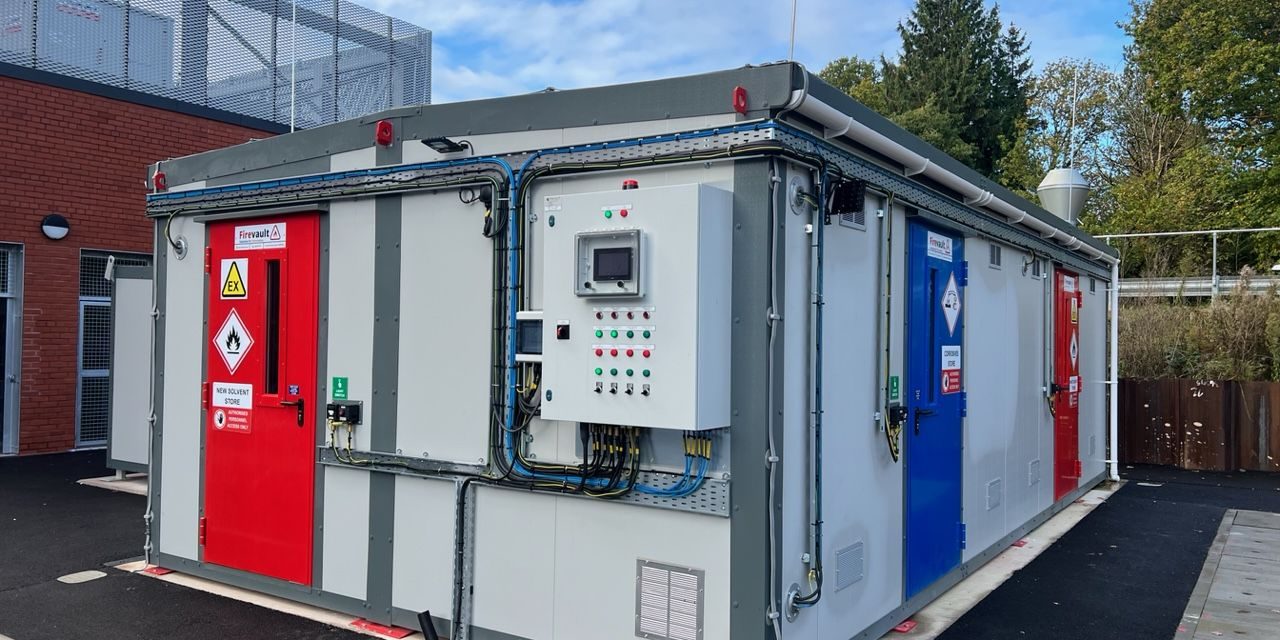
As temperatures soar and heatwaves become more frequent across the UK, Mike Brodie, Managing Director of Chemstore UK, warns that businesses storing hazardous materials must take extra precautions to reduce the growing risk of industrial fires, chemical instability, and dangerous storage failures during periods of extreme heat.
High ambient temperatures can significantly increase the likelihood of industrial fires, thermal runaway events, chemical degradation, and dangerous storage failures, particularly where hazardous substances are not stored correctly.
Research into industrial incidents linked to extreme weather has shown that heatwaves can act as a major risk amplifier for fires involving hazardous materials, overheating equipment, batteries, chemicals, and combustible products.
In our experience, many businesses underestimate just how quickly temperatures can build up inside poorly specified storage units during hot weather. What may seem like a safe storage environment can rapidly become dangerous when exposed to prolonged heat or direct sunlight.
Every hazardous chemical has specific handling and storage requirements detailed within its Safety Data Sheet (SDS), particularly in Sections 7 and 9. Yet one of the most common and dangerous oversights we encounter is failing to adhere to temperature guidelines.
Storing substances outside their recommended temperature range doesn’t just reduce product quality, it can create serious safety hazards. During periods of extreme heat, containers exposed to direct sunlight can reach temperatures far beyond ambient conditions, dramatically increasing the risk of ignition, decomposition, pressure build-up, or thermal runaway.
Improper temperature control can cause hazardous materials to degrade, react, or combust. Organic peroxides, for example, can enter a runaway reaction above their Self-Accelerating Decomposition Temperature (SADT), producing intense heat and potentially igniting. Fires involving organic peroxides are notoriously difficult to control.
Lithium-ion batteries present another growing concern. Widely used across manufacturing, warehousing, and logistics industries, these batteries can experience thermal runaway, fires, and explosions when overheated. Non-temperature-controlled storage, particularly during heatwaves, significantly heightens these risks.
One of the biggest issues we see is the use of standard single-skin steel containers (often referred to as “fire-resistant”) or converted shipping containers for hazardous storage. While they may appear suitable, they effectively act like ovens in direct sunlight, absorbing and radiating heat. Internal temperatures can rise dramatically above outside conditions. Chemstore engineers have recorded temperatures exceeding 60°C inside these types of units during hot weather.
Take acetone as an example — a commonly used solvent for cleaning metal surfaces prior to painting. Acetone has a boiling point of around 56°C, a flash point of approximately -17°C, and is classified as a highly flammable liquid and vapour. In high-temperature environments, particularly inside poorly ventilated or non-temperature-controlled storage units, acetone can generate significant vapour pressure. If stored in sealed drums or containers, pressure can build rapidly, potentially causing containers to bulge, leak, vent, or even rupture. The resulting vapours can quickly form an explosive atmosphere when mixed with air and may ignite from sparks, static discharge, hot surfaces, or naked flames.
Engineered storage systems — including fire-rated, insulated, and climate-controlled units — offer vital protection for both people and products. These systems are designed to prevent heat build-up, maintain stable storage conditions, and provide passive fire resistance should an incident occur.
Compliance is equally important. Businesses storing dangerous substances should undertake a DSEAR assessment (Dangerous Substances and Explosive Atmospheres Regulations) to ensure storage arrangements, ventilation systems, and any electrical equipment are suitable for potentially explosive atmospheres.
Two storage units may look identical externally, but only one may actually meet the required fire safety and electrical ATEX standards. We regularly encounter situations where businesses unknowingly compromise safety through poor specification or unsuitable modifications.
As temperatures continue to rise, hazardous storage is no longer simply a compliance issue, it is increasingly a fire prevention priority.
At Chemstore UK, we work with businesses to properly assess storage risks and provide compliant, temperature-controlled solutions tailored to the materials being stored. With hotter summers becoming the norm, companies should urgently review whether their hazardous storage arrangements are genuinely fit for purpose.
For more information, visit www.chemstore.co.uk
Read other recent news: https://industrial-compliance.co.uk/category/news/