Manual carton opening is one of the most routine tasks in logistics and fulfilment, but it is also one of the easiest to overlook. Health and Safety Executive (HSE) guidance on manual handling of articles with sharp edges warns that such tasks can cause as many as a third of all accidents among stores and warehouse staff. Here, Nigel Smith, CEO of TM Robotics, CASI’s UK and European sales partner, explains how automated box opening can reduce reliance on handheld knives while supporting more consistent throughput.
Operators use knives to open boxes, break down packaging and prepare goods for the next stage of the process. The task is familiar, fast-moving and often repeated hundreds or thousands of times per shift. However, familiarity should not be confused with low risk.
For many warehouses, carton opening still sits outside the main automation conversation. Investment often focuses on automated storage, mobile robots, sorting systems, warehouse management software and data-led inventory control. These technologies matter, but they do not remove every manual bottleneck. In many facilities, inbound processing still depends on people opening cartons by hand.
This creates several operational challenges. As warned by the HSE, handheld knives can expose workers to cuts and puncture injuries, particularly when teams are handling high volumes. The risk can increase when boxes vary in size, tape placement, material thickness or product layout. Repetitive cutting, lifting and turning can also contribute to fatigue, while inconsistent opening methods can increase the risk of damaging goods inside the box.
Carton opening therefore deserves more attention as part of the wider warehouse automation strategy. The question is not whether an operator can open a box manually. The better question is whether a high-volume logistics operation should rely on handheld knives for a repetitive, safety-critical and throughput-sensitive process when a more controlled alternative is available.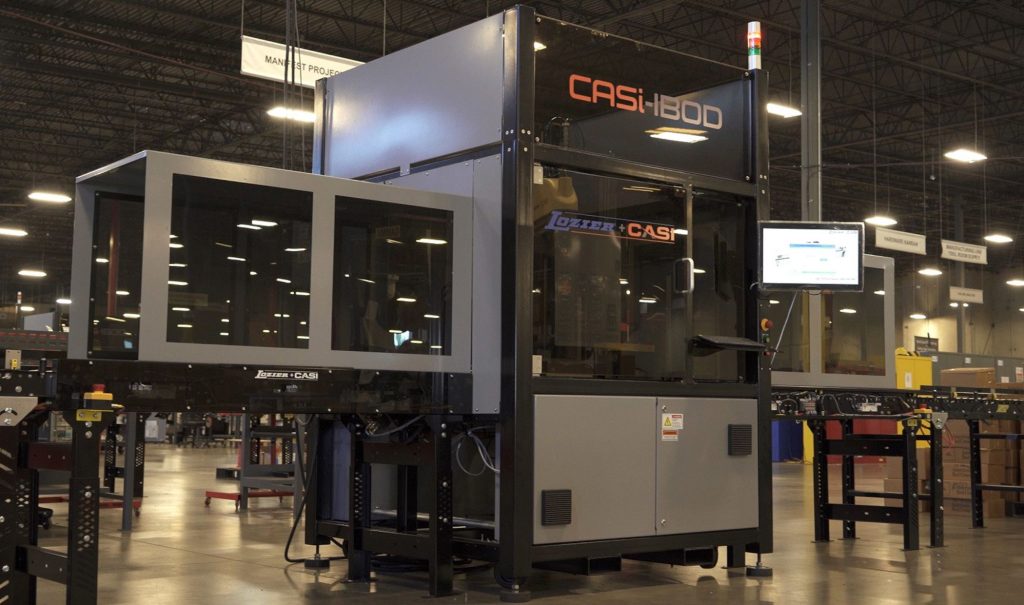
Automation provides a way to redesign the task. Instead of asking workers to carry out repetitive cuts at speed, automated carton-opening systems can use robotics, sensing and controlled cutting to process boxes more consistently. This can help reduce manual knife use, improve repeatability and create a more predictable inbound flow.
The business case is strengthened by wider investment trends. According to Logistics UK and HSBC UK’s Logistics Investment Insight Report 2026, more than 77 per cent of respondents reported increasing technology spend in 2026 compared with the previous year. The report also points to an environment where resilience, data, automation and decision speed are becoming increasingly important to logistics competitiveness.
Automating smaller tasks
For warehouse operators, automation should not only be considered for the most visible areas of the operation. Sometimes, the best opportunities are found in everyday tasks that sit between larger systems. Opening cartons is a good example because it affects labour use, safety, product handling, inbound speed and downstream consistency.
CASi-IBOD, the intelligent Box Opening Device developed by CASI, shows how this can work in practice. The system automates carton opening in logistics and warehousing environments, using sensing and controlled cutting to handle boxes in a safer and more repeatable way. Rather than relying on an operator to judge every cut manually, it brings more control to a task that is often variable by nature.
Warehouses may deal with different box dimensions, changing product types and inconsistent packaging. Automation can help manage this variability by applying a controlled process each time, reducing dependence on individual operator technique.
The safety benefit is clear: fewer manual cuts should mean less reliance on handheld knives. But the operational benefit is just as important. A repeatable opening process can help stabilise inbound flow, reduce disruption and make it easier to plan downstream activity. When cartons are opened consistently, goods can move more smoothly into inspection, picking, sorting, storage or fulfilment.
Automation also changes the role of the operator, allowing staff to focus on judgement, supervision, exception handling and quality control. These factors matter, with reliability and accuracy being the top criteria for selecting a logistics partner according to 32.1 per cent of buyers of third-party logistics services surveyed by Transport Intelligence, ahead of price at 20.5 per cent.
Manual carton opening may be familiar, but the HSE’s warning around sharp-edge handling shows why it should not be accepted as the default. By automating carton opening, logistics businesses can reduce reliance on knives, support safer working practices and create a more consistent first step in the inbound process.
To learn more about CASi-IBOD and TM Robotics’ logistics automation support, visit the TM Robotics website.
Read other recent news: https://industrial-compliance.co.uk/category/news/