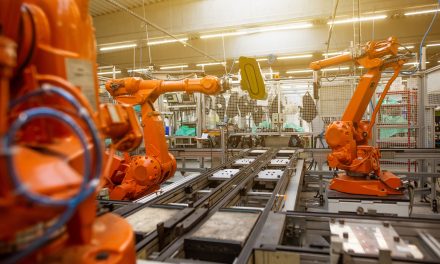
Spend five minutes in a commercial bakery and the environment speaks for itself. Ovens run hot, conveyors rarely stop and a fine layer of flour finds its way onto almost every surface. It’s an environment defined by temperature extremes, contamination and tight production schedules. In this environment, small mechanical components are expected to perform flawlessly, and that includes industrial bearings. Here, Chris Johnson, managing director of bearing specialist SMB Bearings, explains how selecting heat resistant, sealed bearings can improve reliability in bakery operations.
The scale of the commercial bakery sector makes reliability non-negotiable. According to the Food and Drink Federation, food and drink manufacturing is one of the UK’s largest manufacturing sectors. It contributes over £35 billion annually to the UK manufacturing turnover, which is almost a quarter of the total.
Bakeries represent a significant share of that output. Because of this, high throughput production, retailer supply contracts and narrow operating margins leave little room for unplanned downtime.
Reliability isn’t a luxury
So, where do small industrial bearings fit into all of this? Industrial bearings are positioned near burners, within oven conveyors or adjacent to industrial dryers. They operate under sustained elevated temperatures, conditions that accelerate lubricant oxidation and degradation.
Put simply, as oxidation progresses, grease loses its viscosity and film strength. This weakens the lubricating barrier between the rolling elements and raceways in bearings.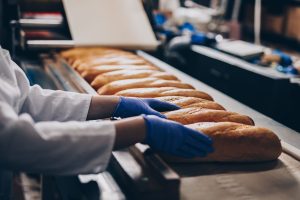
Friction rises and internal temperatures increase further, creating a cycle that rapidly shortens bearing life.
To give a bigger picture, around one fifth of global energy consumption is used to overcome friction according to the Global impact of friction on energy consumption, economy and environment report from the Faculty of Mechanical Engineering, Belgrade. Therefore, tribological losses represent a measurable share of total energy demand in industrial systems.
Production stoppages
Some bearings are designed specifically for moderate industrial temperatures. But, in many cases, these components only survive a fraction of their intended lifespan inside demanding food manufacturing equipment, like a tunnel oven assembly. When grease breaks down, metal-to-metal contact increases wear and can result in the bearing seizing up. Production does not slow gracefully in these moments, it stops entirely.
Another issue is thermal expansion which introduces a second, less visible threat. As shafts heat up, they expand. As the shaft expands with heat, it can squeeze the bearing internally. That unwanted preload raises friction and stress, shortening service life.
Again, in line with the study from Faculty of Mechanical Engineering, increased contact stress accelerates fatigue and raises power consumption. Over months of continuous operation, the cumulative effect becomes measurable, both in terms of maintenance frequency and energy demand, and impacts the reliability of equipment.
Contamination compounds the challenge
Not only should food equipment be reliable and well-maintained, it must also be kept clean to prevent contamination, in line with the UK Food Standards Agency’s safer food better business guidance.
Similar rules apply to the United States, where the FDA’s Current Good Manufacturing Practice regulations state that equipment must be adequately maintained and designed to protect against contamination. Mechanical failure is more than an engineering inconvenience. In food production, it’s a major safety concern.
Flour dust is fine, persistent and poses an airborne risk to machinery. Once inside a bearing, flour mixes with degraded grease to form an abrasive compound. This accelerates wear on raceways and rolling elements, particularly in high-speed conveyor applications.
Moisture from washdowns and steam from proofers adds another dimension. Bearings not designed for humid or chemically exposed conditions may begin to corrode. Surface pitting undermines load distribution and reduces fatigue life. What begins as minor surface damage can develop into vibration, noise and early failure.
When failure occurs in a high throughput bakery, the consequences extend beyond the component itself. Ovens must cool before maintenance teams can intervene safely. Product in process may be lost. Restart procedures consume both time and energy.
For manufacturers operating under strict delivery schedules, even short stoppages disrupt supply chains.
Specification should be strategic, not routine
Reducing friction through specialty bearings for food manufacturing and lubrication therefore contributes directly to efficiency gains. The right bearing choice protects uptime, supports compliance and contributes to energy performance.
Bearing replacements are frequently treated as an unavoidable maintenance routine. In reality, many of these failures stem from specification that doesn’t reflect the true environmental conditions.
By examining operating temperature, contamination levels and washdown exposure in detail, it becomes possible to recommend heat resistant, sealed bearings and corrosion resistant bearings that materially extend service life.
The objective is not to overengineer, it’s to align engineering decisions with operational reality. Let’s look at some examples.
Heat resistant bearings equipped with high temperature lubricants are formulated to resist oxidation and maintain film integrity under sustained thermal load. By preserving lubrication stability, they reduce friction and slow wear progression.
Specifying appropriate internal clearance for elevated operating temperatures helps accommodate thermal expansion without imposing excess stress.
Sealed designs are equally important in flour heavy environments. Effective contact seals reduce particulate ingress while retaining lubricant within the bearing cavity. In washdown zones, corrosion resistant materials such as 316 stainless steel provide added resilience against moisture and cleaning agents.
As the UK’s largest manufacturing sector continues to modernise and scale, reliability will define competitive advantage. Bakeries that view bearing selection through the lens of heat stability, contamination control and energy efficiency will reduce disruption and protect both product integrity and margin.
In environments where ovens never truly cool and conveyors rarely stop, small mechanical decisions make a measurable difference.
Speaking with a bearing specialist can simplify the bearing selection process, visit SMB Bearings website to learn more about bearings for food and beverage manufacturing.
Read other recent news: https://industrial-compliance.co.uk/category/news/